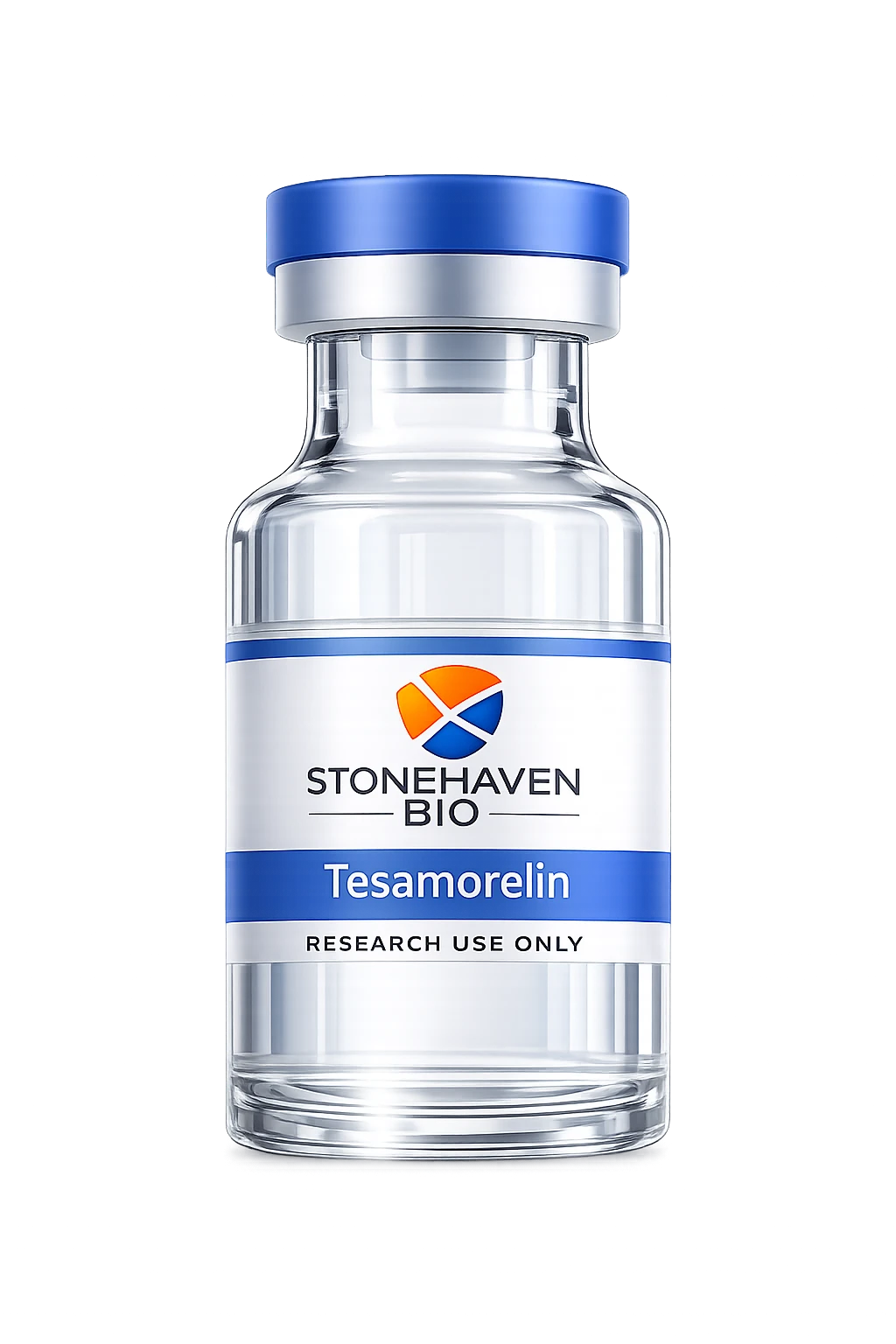
Educational Guide
What Is Tesamorelin? The FDA-Approved GHRH Analog Explained
An accessible explanation of tesamorelin as a synthetic GHRH analog that stimulates endogenous growth hormone release rather than supplying HGH directly. The article clarifies its FDA-approved role in reducing excess abdominal fat in adults with HIV-associated lipodystrophy, distinguishes visceral-fat effects from general weight loss, and explains why broader uses require caution.

Tesamorelin’s role in the growth hormone axis
Tesamorelin is a synthetic analog of growth hormone-releasing hormone, or GHRH. GHRH is the upstream signal the hypothalamus normally uses to prompt the pituitary gland to release growth hormone. Tesamorelin is therefore not recombinant human growth hormone, and it does not supply growth hormone directly from outside the body.
Instead, tesamorelin acts at the pituitary GHRH receptor. In a responsive hypothalamic-pituitary axis, that stimulation increases endogenous growth hormone release and downstream insulin-like growth factor 1, or IGF-1. This distinction is central: tesamorelin amplifies an upstream physiological signal rather than bypassing the axis with exogenous growth hormone.
What the molecule is
Tesamorelin was developed under the code TH9507. It contains the native 44-amino-acid sequence of human GHRH with an N-terminal trans-3-hexenoyl modification. That modification increases resistance to rapid enzymatic degradation by DPP-4, helping make once-daily exposure practical in prescription formulations.
The molecule has appeared in multiple prescription formulations and brand generations, including Egrifta, Egrifta SV, and Egrifta WR. These formulations are not interchangeable because they differ in strengths, reconstitution instructions, injection volumes, and labeled doses.
How tesamorelin differs from direct HGH
Direct recombinant human growth hormone places growth hormone into circulation from outside the body. Tesamorelin takes a different route: it stimulates the pituitary to generate an endogenous growth hormone signal, which then acts on tissues and increases IGF-1.
That does not mean tesamorelin is automatically a safer form of HGH. The more precise distinction is mechanistic. Tesamorelin requires a functioning pituitary response and leaves the growth hormone axis working through feedback-regulated signaling, while direct HGH bypasses the upstream signal.
| Category | Tesamorelin | Direct recombinant HGH |
|---|---|---|
| Primary signal | GHRH-receptor agonism upstream of growth hormone release | Exogenous growth hormone supplied directly |
| Pituitary response required | Yes | No |
| Growth hormone pattern | Stimulates endogenous release | Exposure is determined by administration of HGH |
| Feedback context | Works within feedback-regulated GH-axis signaling | Bypasses the upstream GHRH-pituitary signal |
| Best-supported research focus in this context | HIV-associated excess visceral abdominal fat | Approved indications vary by product and are not the same as tesamorelin’s indication |
The FDA-approved indication is narrow
Tesamorelin was approved by the FDA in 2010 for reducing excess abdominal fat in adults with HIV-associated lipodystrophy. The current Egrifta WR labeling retains this specific indication and states that the product is not indicated for weight-loss management.
This distinction matters because tesamorelin is often discussed as though any abdominal fat is the same research target. The strongest evidence comes from defined clinical populations, especially adults living with HIV who had central fat accumulation. Broader biological hypotheses may be scientifically interesting, but they do not establish the same clinical effect in healthy adults, general obesity, or cosmetic body-composition use.
Why visceral fat is central to the evidence
Visceral adipose tissue is fat located behind the abdominal wall and around internal organs. It differs from subcutaneous fat, which lies under the skin. Visceral fat is associated with insulin resistance, dyslipidemia, inflammatory signaling, and ectopic fat deposition in organs such as the liver.
Tesamorelin’s pivotal trials were notable because the effect was depot-selective: visceral fat decreased, while abdominal subcutaneous fat was largely preserved. Body weight changed relatively little. That pattern helps explain why tesamorelin is better described as a visceral-fat and body-composition compound than as a general weight-loss drug.
The endpoints used to understand tesamorelin’s effects are therefore different from simple scale weight. Waist circumference and imaging-based estimates of visceral fat, such as CT or DEXA measures used in research settings, align more closely with the mechanism and trial outcomes than body weight alone.
Broader research questions require careful boundaries
Tesamorelin has raised broader research interest in liver fat, GH-axis biology, metabolic risk, and age-related physiology. Those questions remain distinct from the FDA-approved indication. The mechanism may be relevant beyond HIV-associated lipodystrophy, but the magnitude and reliability of clinical effects cannot simply be assumed to transfer to other populations.
The most defensible conclusion is specific: tesamorelin demonstrates that upstream, feedback-intact stimulation of the growth hormone axis can selectively alter visceral fat biology in humans within the studied populations. Claims beyond that should preserve the population, endpoint, and evidence limitations attached to the findings.
References
- FDA: EGRIFTA WR Prescribing Information (revised March 2025)
- Falutz et al. Metabolic Effects of a Growth Hormone-Releasing Factor in Patients with HIV. New England Journal of Medicine, 2007.
- Falutz et al. Effects of tesamorelin in HIV-infected patients with abdominal fat accumulation: pooled Phase 3 analysis and safety extension. Journal of Clinical Endocrinology & Metabolism, 2010.