
Research Article
BPC-157 Mechanisms: Tissue Repair, Nitric Oxide Signaling, Angiogenesis, and Human Evidence Limits
An evidence-aware overview of BPC-157 as a regenerative peptide, explaining proposed mechanisms such as nitric oxide regulation, angiogenesis, cell migration, gut barrier repair, inflammatory modulation, and possible growth hormone receptor upregulation. The article emphasizes that the strongest support remains preclinical, while high-quality human clinical evidence is very limited.
BPC-157 as a regenerative peptide candidate
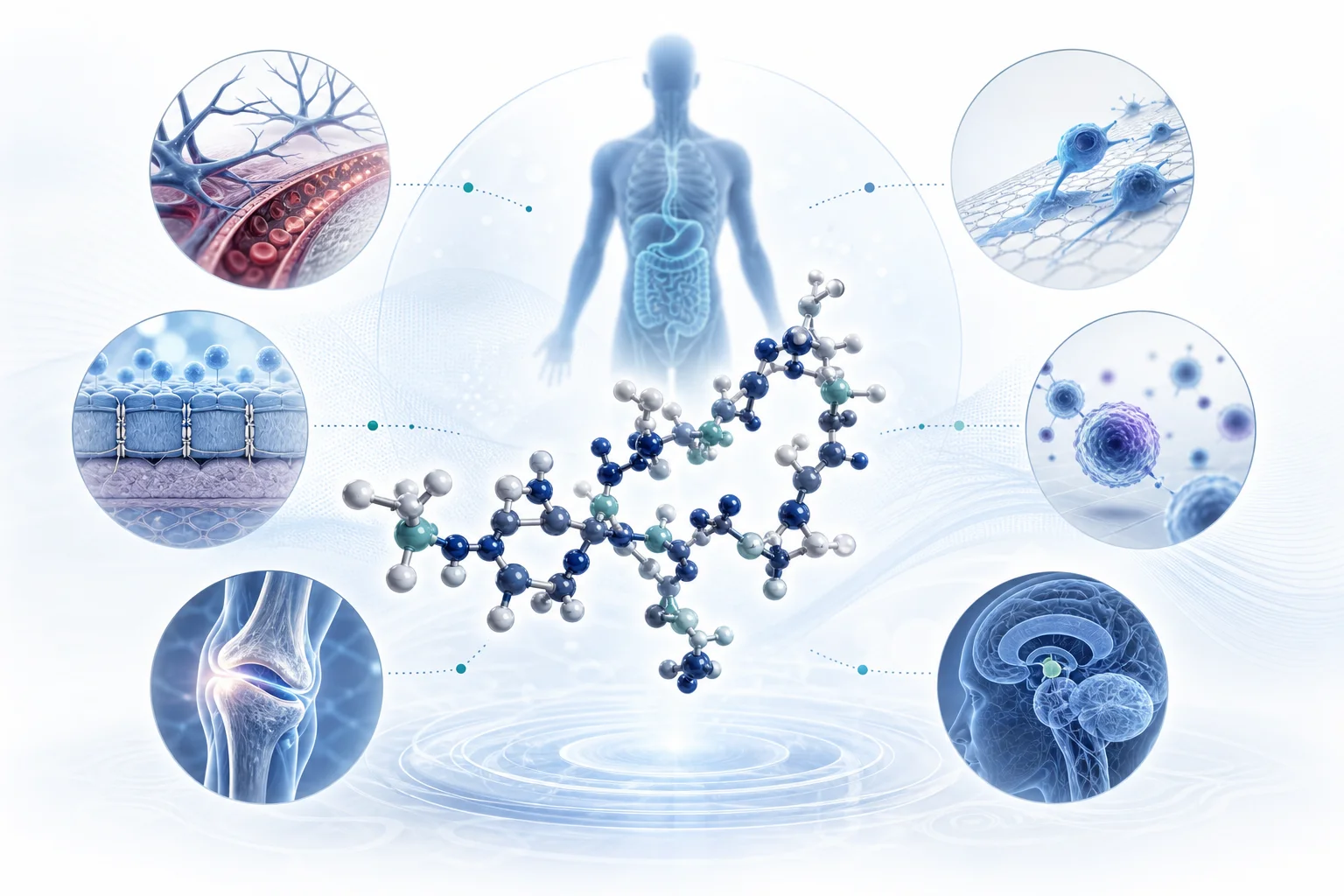
BPC-157, short for Body Protection Compound-157, is a peptide that has attracted research interest because of its proposed role in tissue repair rather than direct anabolic or performance-enhancing effects. It is commonly discussed as a regenerative peptide because preclinical work has examined activity across multiple tissue types, including tendons, ligaments, skeletal muscle, bone, peripheral nerves, gastrointestinal tissue, liver, blood vessels, brain, and heart.
The peptide’s historical background is tied to gastric juice research and work associated with Professor Predrag Sikiric at the University of Zagreb, including a 1992 patent. Its gastric origin and reported stability in gastric acid are part of why oral administration is discussed more often for BPC-157 than for many other peptides. That feature should not be interpreted as proof of clinical efficacy; it is a mechanistic point that helps explain why gut-focused research has been prominent.
A systems-level repair model
A useful way to understand BPC-157 is that it does not appear to act through one dominant receptor or a single isolated pathway. Instead, it is discussed as a systems-level coordinator that may influence several repair-related processes at once. This distinguishes it conceptually from more pathway-specific peptides, such as those discussed primarily in relation to mitochondria, immune signaling, cytokine modulation, or the growth hormone axis.
The central research idea is not that BPC-157 forces one biological switch, but that it may help coordinate the environment in which repair occurs. Proposed mechanisms include nitric oxide regulation, angiogenesis, cell migration, fibroblast recruitment, collagen deposition, gut barrier restoration, inflammatory modulation, and possible growth hormone receptor upregulation.
Proposed mechanisms involved in repair signaling
Several mechanisms have been proposed to explain why BPC-157 has generated interest in tissue repair research. These mechanisms are interconnected: blood vessel formation may affect nutrient delivery, cell migration may affect wound organization, and barrier repair may influence downstream inflammatory signaling.
| Mechanism | Key biological elements | Evidence-aware interpretation |
|---|---|---|
| Nitric oxide regulation | eNOS, VEGFR2, Src kinase, two-way nitric oxide regulation | BPC-157 appears to normalize nitric oxide signaling rather than simply increase it, but this remains a proposed mechanism rather than a proven clinical effect. |
| Angiogenesis | VEGF signaling, capillary formation, improved blood supply, nutrient delivery | New blood vessel formation is relevant to repair biology, especially in tissues where vascularity can limit healing, but human outcome evidence remains limited. |
| Cell migration and matrix organization | FAK, paxillin, fibroblast recruitment, collagen deposition | These processes may help explain observations in tendon, ligament, muscle, and wound-repair models. |
| Gut barrier repair | ZO-1, occludin, tight junction repair, intestinal permeability | This mechanism supports interest in gastrointestinal models, including NSAID injury, ulcer healing, and inflammatory bowel disease contexts, while not establishing clinical use. |
| Inflammatory modulation | TNF, IL-6, IL-1β, secondary inflammation after tissue injury | BPC-157 is discussed as reducing secondary inflammation as repair improves, rather than acting only as a direct cytokine-suppressing agent. |
| Growth hormone receptor upregulation | Possible increase in receptor availability without increasing hormone levels | This may create biologically plausible interaction with growth hormone-axis compounds, but direct human evidence for such strategies is lacking. |
Nitric oxide regulation
Nitric oxide signaling is one of the more distinctive mechanisms discussed for BPC-157. Rather than functioning like a simple nitric oxide booster, BPC-157 is described as having a two-way regulatory effect that may help normalize nitric oxide activity. Pathways and mediators discussed in this context include eNOS, VEGFR2, and Src kinase.
Angiogenesis and vascular support
Angiogenesis, the formation of new blood vessels, is central to many repair processes because oxygen, nutrients, and immune cells depend on vascular access. BPC-157 research has focused on VEGF-related signaling, capillary formation, and improved blood supply as possible contributors to tissue recovery in preclinical models.
Gut barrier, connective tissue, and nervous system research areas
BPC-157 is often discussed in relation to connective tissue because preclinical work has examined tendons, ligaments, muscle strains, and bone repair. Areas of interest include Achilles and patellar tendon models, rotator cuff and elbow-related injury contexts, ligament injury models, skeletal muscle recovery, and fracture or bone-remodeling research.
Gastrointestinal research is another major area. Proposed mechanisms include repair of tight junction proteins such as ZO-1 and occludin, improved barrier integrity, and effects on intestinal permeability. These mechanisms are why BPC-157 is discussed in relation to leaky gut physiology, inflammatory bowel disease contexts such as Crohn’s disease and ulcerative colitis, NSAID-associated injury, alcohol-related injury, short bowel syndrome models, and ulcer healing.
Additional preclinical areas include liver injury models, peripheral nerve regeneration, neuropathy or compression-related nerve research, stroke, brain injury, spinal cord injury, and cardiovascular contexts. Some animal studies have also explored mood-related pathways involving dopamine and serotonin. These areas are scientifically interesting but should be interpreted with particular caution because animal nervous system and cardiovascular findings often do not translate directly into human clinical outcomes.
Human evidence remains a major limitation
The strongest support for BPC-157 remains preclinical. Across several decades, animal studies have produced consistent signals across multiple tissues, and the mechanistic rationale is broad. That breadth helps explain why the peptide receives attention in regenerative and repair-focused discussions.
The human evidence base is much smaller. High-quality clinical evidence remains extremely limited, with fewer than 30 published human subjects and no large randomized controlled trials. Clinical development has also been described as stalled. These limitations substantially reduce confidence about efficacy, appropriate clinical use, long-term safety, and translation from animal models to people.
How to interpret BPC-157 responsibly
BPC-157 is most accurately framed as a research-focused regenerative peptide candidate with unusually broad proposed mechanisms. It may influence repair biology through nitric oxide regulation, angiogenesis, cell migration, gut barrier repair, inflammatory modulation, and growth factor-related signaling. That systems-level profile is the reason it is often described as a repair-oriented compound rather than a single-pathway intervention.
At the same time, the gap between animal research and human clinical certainty remains large. The most responsible interpretation is balanced: BPC-157 has a strong preclinical rationale and multiple biologically plausible mechanisms, but high-quality human trials are lacking. Any discussion of clinical application should account for that uncertainty rather than treating preclinical findings as established medical outcomes.
Related products
Related Stonehaven Insights
Research Article
BPC-157 for Tendon, Ligament, Muscle, Bone, and Nerve Recovery: What the Evidence Can and Cannot Show
Research Article
Oral BPC-157 and Gut Barrier Repair: Tight Junctions, NSAID Injury, IBD Models, and Ulcer Research
Educational Guide