
Research Article
Oral BPC-157 and Gut Barrier Repair: Tight Junctions, NSAID Injury, IBD Models, and Ulcer Research
A gastrointestinal-focused explanation of why oral BPC-157 is discussed in relation to gut barrier physiology, tight junction proteins, intestinal permeability, inflammatory bowel disease models, NSAID-related gastrointestinal injury, alcohol-related injury, and ulcer healing. The article separates mechanistic and preclinical rationale from the current limitation: robust human clinical evidence is still lacking.
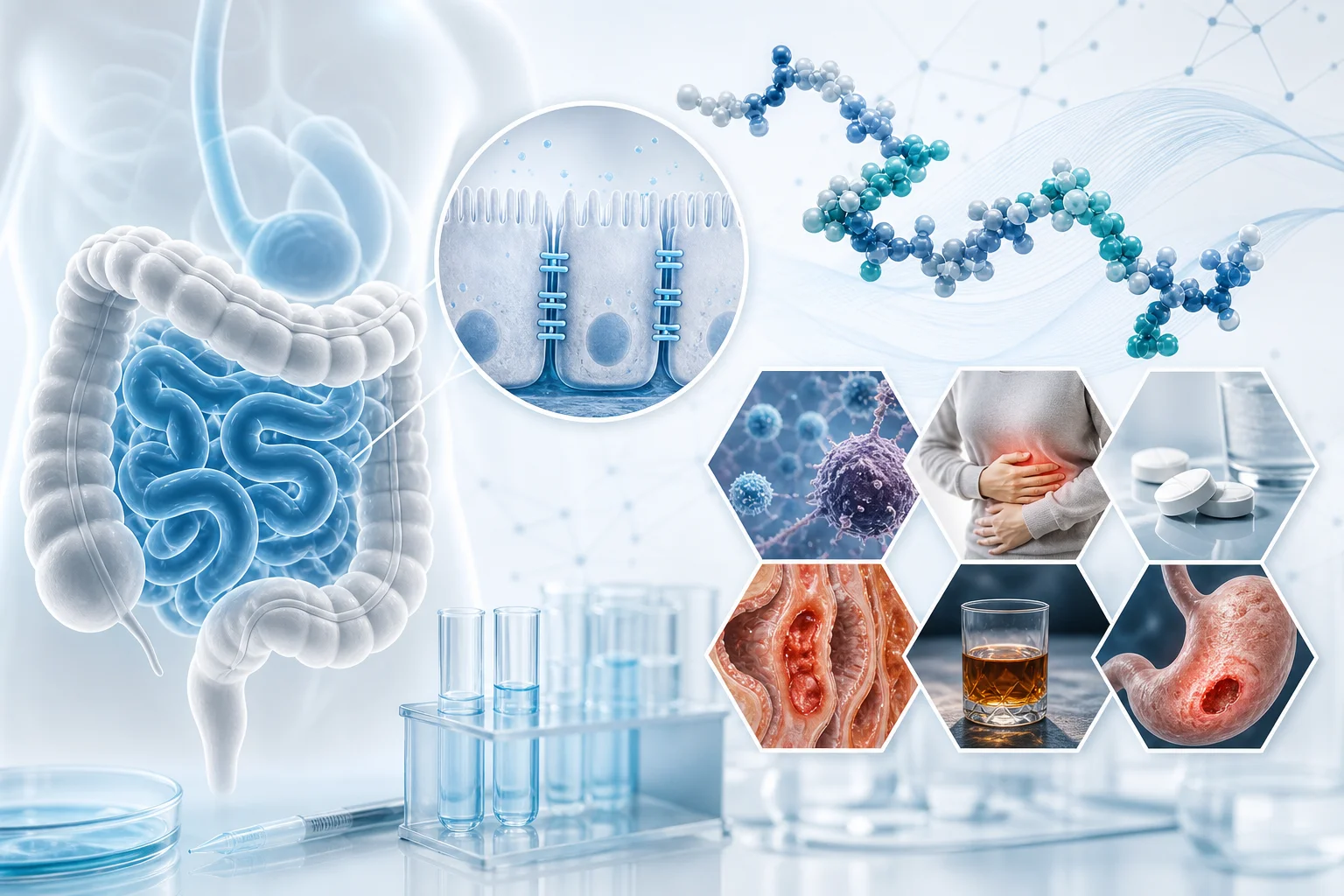
Why oral BPC-157 is discussed in gut barrier research
BPC-157, also referred to as Body Protection Compound-157, is a peptide associated in preclinical research with tissue repair across several organ systems, including gastrointestinal tissue. Its gastrointestinal relevance is partly historical: BPC-157 has been linked to a gastric juice origin, and its reported stability in gastric acid makes oral administration an unusual but biologically plausible route of interest for gut-focused research.
The strongest rationale for oral BPC-157 in this area is not that it has been proven as a clinical therapy for gut disorders. Rather, it is that several mechanisms repeatedly discussed in BPC-157 research overlap with core features of gastrointestinal repair: epithelial barrier integrity, tight junction function, intestinal permeability, inflammation around damaged tissue, blood vessel support, and ulcer healing.
Gut barrier physiology and tight junction repair
The intestinal barrier depends on coordinated epithelial structure and signaling. One important part of that barrier is the tight junction system, which helps regulate what passes between intestinal epithelial cells. In BPC-157 discussions, two tight junction proteins are especially relevant: ZO-1 and occludin.
When tight junction integrity is impaired, intestinal permeability can increase. This is sometimes described informally as “leaky gut,” although the more precise research concept is altered intestinal permeability. BPC-157 is often discussed in this context because gut barrier repair appears to be one of its more compelling mechanistic areas, especially for oral administration.
The proposed barrier-related rationale includes support for ZO-1 and occludin, repair of tight junction structure, and reduction of secondary inflammation as damaged tissue recovers. These mechanisms remain primarily mechanistic and preclinical rather than established through large human randomized trials.
Mechanisms that may connect BPC-157 with gastrointestinal repair
BPC-157 is not described as acting through one dominant receptor. Instead, it is discussed as influencing several repair pathways at once. In gut tissue, that systems-level profile matters because barrier repair is not a single-step process. It may involve epithelial cell movement, tight junction restoration, local vascular support, inflammatory signaling, and growth-factor-related responses.
One proposed mechanism is regulation of nitric oxide signaling. BPC-157 is discussed in relation to eNOS, VEGFR2, and Src kinase, with the important qualifier that it appears to normalize nitric oxide signaling rather than simply increase it. In gastrointestinal injury contexts, regulated nitric oxide signaling may be relevant because blood flow, vascular responses, and tissue repair must be coordinated rather than broadly stimulated.
BPC-157 is also discussed in relation to angiogenesis, including VEGF-associated blood vessel formation. Better local blood supply is biologically relevant to healing because repair requires oxygen, nutrients, and removal of waste products. In gut injury models, this mechanism is part of the broader rationale for studying BPC-157 in ulcer healing and other gastrointestinal injury settings.
Cell migration, fibroblast recruitment, and collagen deposition
Tissue repair requires cells to move into injured areas and rebuild structure. BPC-157 is discussed in relation to focal adhesion kinase, paxillin, cell migration, fibroblast recruitment, and collagen deposition. These mechanisms are not unique to the gut, but they are relevant to damaged gastrointestinal tissue because epithelial restoration and underlying connective tissue repair both require coordinated cellular movement and matrix remodeling.
The same systems-level framing also helps explain why BPC-157 is discussed across tendons, ligaments, muscle, bone, nerves, blood vessels, liver, brain, heart, and gastrointestinal tissue. For gut barrier research, the important point is narrower: multiple repair processes that matter to gastrointestinal injury appear to overlap with mechanisms attributed to BPC-157 in preclinical work.
Research contexts: IBD models, NSAID injury, alcohol injury, and ulcers
Gastrointestinal research interest in BPC-157 extends beyond general permeability. It is discussed in relation to inflammatory bowel disease contexts, including Crohn’s disease and ulcerative colitis, as well as NSAID-related gastrointestinal injury, alcohol-related injury, short bowel syndrome, and ulcer healing. These topics should not be interpreted as equivalent levels of clinical evidence; they represent areas where the peptide’s repair mechanisms are considered relevant or have been explored in preclinical research.
| Topic | Why it is relevant to BPC-157 discussions | Evidence limitation |
|---|---|---|
| Intestinal permeability | Tight junction repair, including ZO-1 and occludin, is a central mechanistic rationale. | Human clinical evidence remains limited. |
| IBD-related contexts | Crohn’s disease and ulcerative colitis are discussed as gut inflammatory disease areas where barrier integrity and tissue repair matter. | Robust human trials are lacking. |
| NSAID-related gastrointestinal injury | NSAID injury is relevant because gastrointestinal tissue damage, inflammation, and repair pathways are central to the proposed rationale. | Evidence should be interpreted cautiously without large randomized clinical trials. |
| Alcohol-related gastrointestinal injury | Alcohol injury is discussed as a gastrointestinal damage context where repair and barrier restoration may be relevant. | Clinical certainty is not established. |
| Ulcer healing | Ulcer healing aligns with proposed mechanisms involving angiogenesis, blood supply, cell migration, and tissue repair. | Preclinical and mechanistic rationale should not be treated as proof of clinical efficacy. |
Inflammation and repair: a different emphasis from direct cytokine suppression
BPC-157 is often discussed alongside inflammation, but its proposed role is not simply that of a direct anti-inflammatory compound. A useful distinction is between directly reducing cytokine signaling and reducing secondary inflammation as tissue repair progresses. In BPC-157 discussions, cytokines such as TNF, IL-6, and IL-1β are relevant, but the broader emphasis is on creating conditions in which damaged tissue can recover.
This differs from peptides framed primarily around cytokine modulation, such as KPV. In comparison, BPC-157 is more often presented as a repair-oriented peptide: barrier restoration, vascular support, cell migration, and tissue remodeling are central to the rationale. That distinction matters for gut barrier research because inflammation and barrier damage can reinforce each other, but improving one does not automatically prove improvement in the other in humans.
Human evidence remains the central limitation
The evidence base for BPC-157 is described as broad and mechanistically consistent across animal and laboratory research, but high-quality human clinical evidence remains extremely limited. Across the wider BPC-157 literature discussed here, there are fewer than 30 published human subjects and no large randomized controlled trials.
This limitation is especially important for gastrointestinal claims. Findings related to ZO-1, occludin, angiogenesis, nitric oxide signaling, cell migration, NSAID injury, alcohol injury, IBD models, and ulcer healing may support a biologically plausible research rationale. They do not establish that oral BPC-157 reliably repairs the gut barrier or improves gastrointestinal disease outcomes in people.
References
- Professor Predrag Sikiric, University of Zagreb; 1992 patent related to BPC-157 and Body Protection Compound research.
Related products
Related Stonehaven Insights
Research Article
BPC-157 Mechanisms: Tissue Repair, Nitric Oxide Signaling, Angiogenesis, and Human Evidence Limits
Research Article
BPC-157 for Tendon, Ligament, Muscle, Bone, and Nerve Recovery: What the Evidence Can and Cannot Show
Educational Guide